
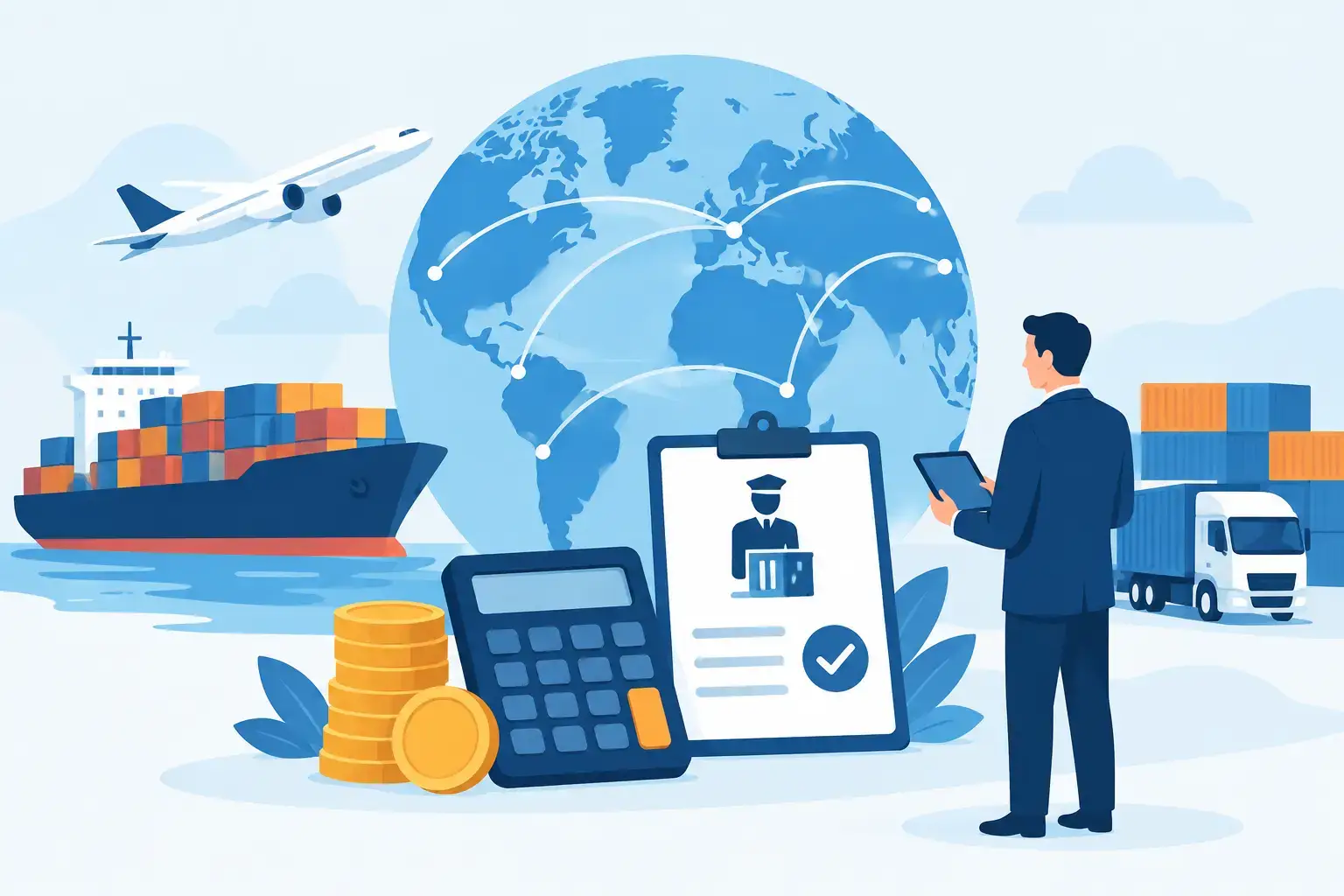
A product can look commercially viable until it reaches the border. Import duty calculation is where a promising international sales plan becomes a real cost model – or an unpleasant surprise for finance, operations, and the customer. For companies entering new markets, the question is not simply what duty rate applies. It is whether the full landed cost supports the target margin, price position, and speed-to-market plan.
Duty is only one component of import cost, but an error in its calculation can affect every unit sold. A misclassified product, unsupported origin claim, or overlooked customs fee can quickly turn a profitable launch into an expensive correction. The most effective approach is to treat customs cost as a design input for global expansion, not a last-minute logistics charge.
What import duty calculation actually covers
Import duty is a customs charge imposed when goods enter a country or customs territory. It is usually calculated as a percentage of the customs value, although some goods are subject to a fixed amount per unit, weight, or volume. The rate depends on how customs authorities classify the product, where it originated, and the destination market’s tariff rules.
At its simplest, the calculation is:
Import duty = customs value x applicable duty rate
The formula is simple. Establishing the right customs value and applicable rate is not. A reliable calculation requires decisions and documentation across product, commercial, and supply chain functions. This is why duty should be assessed before a market launch, before pricing is finalized, and before an Importer of Record is appointed.
For example, a company exporting a $100,000 shipment may identify a 5% duty rate and budget $5,000. But if the customs value includes freight, insurance, packing, assists, royalties, or other additions under the destination country’s valuation rules, the dutiable amount may be higher. If a preferential origin claim is unavailable, the rate may also be higher than expected. The difference can materially change the landed cost.
The five inputs behind an accurate calculation
1. Product classification
The Harmonized System, commonly called the HS system, is the foundation of customs classification. Every imported product is assigned a code that determines its duty treatment, licensing requirements, possible restrictions, and often product compliance obligations.
The first six digits of an HS code are internationally standardized, but countries frequently add further digits for local tariff and statistical purposes. A product classified for export from the United States may therefore need a more specific tariff classification in the destination market.
Classification should reflect the product’s actual composition, function, technical characteristics, and intended use. Marketing names are not enough. A connected device, for instance, may be classified differently depending on whether its principal function is measurement, communication, control, or computing. Small differences in product design can change the duty outcome.
2. Customs value
Customs value is not always the invoice total. In many cases, authorities use the transaction value – the price actually paid or payable for the goods – then require specific additions. These can include certain packing costs, selling commissions, tooling or materials supplied by the buyer, royalties, and proceeds that return to the seller.
Freight and insurance treatment varies by country and transaction structure. Some markets assess duty on a CIF-style value, including cost, insurance, and freight to the port of entry. Others apply different valuation methods. Companies should not assume that Incoterms alone determine the customs value. Incoterms allocate commercial responsibilities between buyer and seller, while customs valuation follows local law.
Related-party sales need particular care. When the buyer and seller are affiliated, customs may require evidence that the relationship did not influence the price. Transfer pricing documentation can support the commercial rationale, but it does not automatically satisfy customs valuation requirements.
3. Country of origin
Country of origin is where a product is considered to have been made for customs purposes. It is not necessarily the shipping country, the seller’s location, or the country printed on the invoice. For products assembled from globally sourced components, origin can depend on whether processing in a country created a substantial transformation under the relevant rules.
Origin matters because it can determine the normal duty rate, exposure to additional tariffs, eligibility for trade agreement preferences, and marking requirements. A product shipped from Germany to Canada may still have Chinese origin for customs purposes, for example, if its qualifying production occurred in China.
Preferential duty rates under free trade agreements can be commercially valuable, but they are not automatic. The importer must be able to substantiate the claim with accurate supplier information and origin records. If proof is incomplete, customs can deny the preference and assess duty retrospectively, often with interest or penalties.
4. The destination market’s tariff measures
The published duty rate is not always the final rate. Importers may face additional tariffs, trade remedies such as anti-dumping or countervailing duties, quota rules, seasonal tariffs, or special measures aimed at certain products and origins.
This is especially relevant for sectors such as electronics, industrial equipment, textiles, consumer goods, metals, and components. A standard tariff code can appear manageable until an origin-specific measure is applied. Product compliance requirements can also delay entry or add cost if documentation, testing, labeling, or registrations are not ready before shipment.
5. Taxes, fees, and clearance costs
Import duty is not the same as the total border cost. Depending on the market, the importer may also pay import VAT, goods and services tax, sales tax, merchandise processing fees, harbor maintenance fees, broker charges, inspection costs, and local delivery expenses.
Some taxes may be recoverable for a properly registered business. Others become a direct cost. The commercial model must distinguish between recoverable cash-flow exposure and unrecoverable landed cost. Finance teams need both views: one to protect margin and another to plan working capital.
A practical import duty calculation process
A dependable process starts with product data, not a freight quote. Gather technical descriptions, composition details, product images, bills of materials where relevant, commercial invoices, manufacturing locations, and information about any royalties or buyer-supplied components. This creates a factual basis for classification, valuation, and origin analysis.
Next, determine the intended import flow. Identify the importer, destination, ship-from location, Incoterms, transfer price or sales price, and whether goods will be sold, stored, repaired, demonstrated, or re-exported. A temporary import for a trade show may use a different customs procedure than inventory entering a local distribution center. Applying a permanent-import duty model to temporary goods can create avoidable cost.
Then calculate the customs value according to the destination market’s rules and apply the confirmed tariff rate. Add any origin-based measures, taxes, fees, and anticipated clearance costs. The result should be a landed-cost model that shows duty as a separate line item rather than burying it inside logistics spend.
A useful commercial calculation is:
Landed cost = product cost + international freight + insurance + duty + nonrecoverable taxes + customs fees + clearance and local delivery costs
This does not replace a country-specific customs calculation. It gives leadership a decision-ready view of the cost to place goods in the target market.
Why scenario planning protects growth
Duty rates and trade measures change. So do product configurations, suppliers, shipping routes, and sales structures. A static spreadsheet built for a first shipment will not provide enough control as volumes increase.
Build scenarios around the variables most likely to affect margin. Model the standard tariff rate and the preferential rate, where a trade agreement may apply. Compare direct shipment with regional distribution. Test a change in manufacturing country or a new component source. Consider whether a bonded warehouse, inward processing procedure, free trade zone, or temporary import arrangement could defer, reduce, or eliminate duty for the intended movement of goods.
These options involve trade-offs. A customs procedure may reduce duty but add administrative requirements, recordkeeping obligations, security requirements, or restrictions on local sale. The right answer depends on shipment frequency, inventory strategy, product lifecycle, and the company’s ability to maintain compliant controls.
Common mistakes that create avoidable exposure
The most frequent mistake is using an assumed HS code from a supplier, marketplace listing, or previous market without validating it for the destination country. Another is relying on the country of shipment as the country of origin. Both can produce incorrect duty rates and customs declarations.
Companies also underestimate the impact of importer responsibility. The Importer of Record is generally accountable for the accuracy of declarations, payment of duties and taxes, and maintenance of required records. Assigning that role without clear operational ownership creates a gap between commercial ambition and customs control.
Finally, duty is often calculated too late. If the calculation happens after customer pricing, distributor agreements, and inventory commitments are already set, the business has fewer ways to respond. Early analysis creates options. Late analysis creates exceptions.
Build duty into the operating model
For one-off shipments, a transaction-level calculation may be enough. For ongoing international growth, import duty needs to sit within the broader operating model. Product teams need a process for flagging design or sourcing changes. Procurement needs origin data from suppliers. Finance needs landed-cost reporting. Operations needs clear ownership of records, brokers, and import declarations.
Logac helps businesses connect those moving parts through tailored global supply chain design, customs coordination, and Importer of Record support. The goal is not simply to clear a shipment. It is to create an import process that remains controlled as products, markets, and volumes grow.
Before committing to a new market, test the import duty calculation against the actual product, transaction, and operating flow you plan to use. A clear customs-cost model gives your team room to price with confidence, protect margin, and expand without discovering the true cost at the border.